A Way of Building Redemptively
We believe the Creator created us to create.
The apostle Paul writes, “For we are God’s handiwork, created in Christ Jesus to do good works, which God prepared in advance for us to do” (Eph. 2:10). We are God’s workmanship before we make anything with our hands. Redemptive building therefore begins not with our productivity, ingenuity, or ambition, but with God’s prior work in us and our dependence on him.

Up to this point, we have developed a theology of technology through the Gospel lenses of creation, deception, redemption, and restoration. We have named the spiritual forces shaping the technological world and considered what it means to approach power, people, and purpose in the way of Jesus.
But theology and posture must become practice. A redemptive way of seeing technology must shape how we identify problems, choose responses, build products, and evaluate their value.
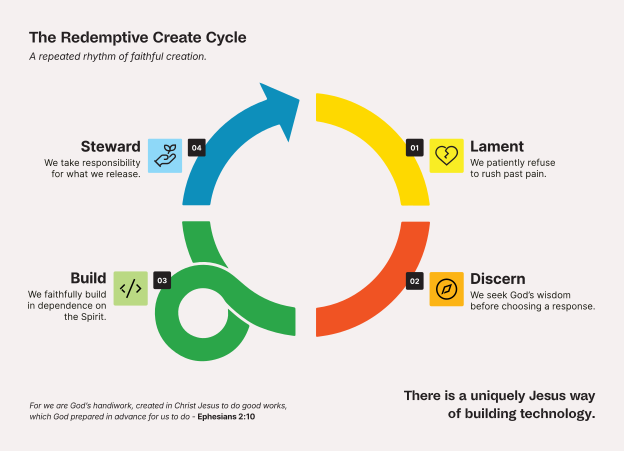
The following four practices offer a way of creating redemptively:
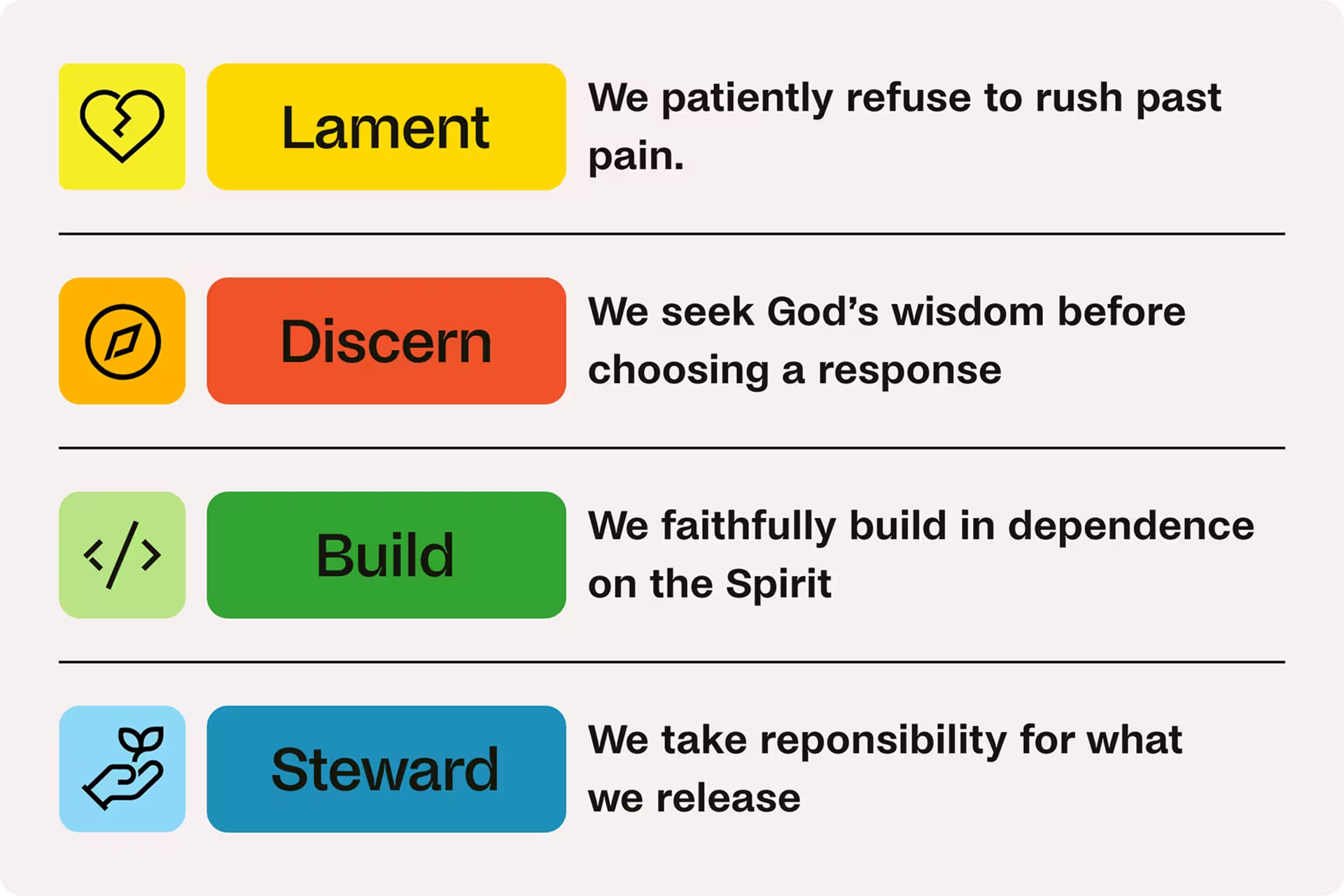
These four practices deepen the original FaithTech 4D framework of Discover, Discern, Develop, and Demonstrate. These form a repeated rhythm with willingness to pause, repent, listen again, change direction, and submit both the process and the product to Jesus. They are not merely four steps to complete once.
Each practice follows the same movement: It names the temptation builders face, considers the way of Jesus, offers a practical response, and concludes with questions that help a team determine what faithfulness requires next.
Together, these practices help move us from conviction to creation—from what we believe about technology to how we create.
We patiently refuse to rush past pain.
Before we reach for a solution, we draw near to the people most affected by the problem. We listen, feel the weight of what is broken, bring it before Jesus, and invite the Holy Spirit to shape both our understanding and our response.
The Temptation
Every product begins with a problem someone believes needs to be solved. Yet builders are often tempted to move toward solutions before they understand the problem deeply.
Sometimes this comes from genuine eagerness to help. At other times, we are captivated by technology’s apparent power and assume that building something must be the answer. Here the Killer App Trap and the reckless posture reinforce one another. We begin to see suffering primarily as a problem to solve, technology as the obvious solution, and ourselves as the people capable of fixing it. Pain becomes a product opportunity before it becomes a reality to enter, grieve, and understand. We risk responding to symptoms rather than causes, solving the wrong problem, or creating products shaped more by our enthusiasm than by the real needs of the people affected.
The first faithful action is therefore not to grasp for power or rush toward a product but to pay attention.
The Way of Jesus
Jesus did not rush past suffering. He saw people, listened to them, and welcomed interruption. Creating in the way of Jesus begins by drawing near rather than solving from a distance.
Jesus said, “My sheep listen to my voice; I know them, and they follow me” (John 10:27). We listen to the people experiencing the problem, and we listen for the guidance of God. We bring the hurts, pain, and injustice before him in prayer, allowing the problem to form our hearts before we attempt to form a solution.
Lament turns pain into prayer. It helps us resist the urge to control the problem and instead place it within the faithfulness and presence of God.
The Practice
Nehemiah models this posture when he hears that Jerusalem’s walls have been destroyed:
Nehemiah does not immediately begin rebuilding. He listens, grieves, prays, repents, and remembers God’s faithfulness. His lament deepens his compassion and prepares him to respond faithfully.
We practice lament together through four movements:
- Listen. Draw near to the people most affected. Ask questions, pay attention, and resist interpreting their experience too quickly.
- Remember. Come before God and name the problem honestly. Describe the pain, injustice, loss, and consequences without minimizing them.
- Repent. Lament must move beyond sorrow into repentance. We allow the truth to search us, acknowledging our assumptions, pride, indifference, and participation in what is broken. Repentance is the turning point where God confronts what is disordered within us so that we do not reproduce it through what we create.
- Rejoice. Recall God’s past faithfulness, express trust in his presence, and ask for his wisdom and intervention as the team moves forward. Testimony of God’s grace and mercy is a prophetic act. He did it before. He can do it again. Praise the Lord.
Lament should not become an endless delay or a performance of empathy. Its purpose is to help us understand truthfully, love compassionately, and approach the next decision without assuming that our first idea is God’s answer.
Before moving forward, the team should be able to answer:
- Whose pain have we listened to directly?
- What assumptions have been challenged?
- What deeper causes may sit beneath the visible problem?
- How might we be contributing to what is broken?
- Are we ready to discern a response, or are we still rushing?
Put simply, Lament interrupts technological urgency with patient presence.

We seek God’s wisdom before choosing a response.
After lamenting the problem, we resist the pressure to build immediately. We pause to seek God’s wisdom, test our assumptions, and determine whether technology is needed, what response is faithful, and how we should proceed.
The Temptation
Discernment is often the easiest stage to ignore.
Once we understand a problem, we quickly begin imagining solutions. We assume that speed is a virtue, disruption is progress, and building something new is better than receiving or adapting what already exists. We return to “move fast and break things,” often without asking whether technology should be the solution at all.
This is where the Killer App Trap becomes especially powerful. We begin to believe that every meaningful problem requires a technical answer and that failing to build means failing to act. The Magic Machine Myth also shapes this moment. Because the technology appears powerful, intelligent, or unprecedented, we can begin to treat what is technically possible as though it is automatically wise. A responsible posture may ask how to build the solution safely; a redemptive posture first asks whether building is wise at all.
The first question is therefore not, “What can we build?” It is, “What response is wisest?”
The Way of Jesus
Jesus did not act from pressure, ambition, or urgency alone. He remained attentive to the Father, withdrew to pray, resisted demands that distracted him from his mission, and acted in step with the Spirit.
Paul writes:
Discernment requires more than choosing between good and bad ideas. It means allowing God to renew our minds so we can recognize the assumptions, desires, and cultural pressures shaping our response.
We ask not only, “How might we solve this problem?” (human-centered) but, “How might Jesus respond?” (Christ-centered) This moves us beyond technical possibility toward faithful obedience.
The Practice
We begin by considering four possible responses we like to call the 3RC:
- Reject. A product is not always the right answer. We may decide that a technical solution would deepen the problem, displace relationships, create dependency, or distract from a more faithful response. Core question to ask: Should a technology product be the solution?
- Receive. A suitable solution may already exist. Rather than creating something new, we receive and use what is already available when it serves the community well and aligns with the redemptive outcomes we are seeking. Core question to ask: Does a redemptive solution already exist?
- Reimagine. Existing technology may be adapted, repurposed, or improved for a more faithful use. Where possible, we build upon what already exists rather than creating unnecessary technical debt. Core question to ask: Is there a solution we can redemptively repurpose?
- Create. When something genuinely needs to be built, we move forward carefully. We consider how the product might be exploited, misused, or abused, and we design guardrails that protect the people and communities it will affect. Core question to ask: How do I build redemptively?
These four responses prevent brainstorming from becoming an automatic path toward building. They give the team permission to stop, receive, adapt, or create.
Discernment should involve prayer, Scripture, wise counsel, technical knowledge, and the voices of those most affected. No single person should carry the decision alone, especially when the product will shape the lives of others.
Before moving forward, the team should be able to answer:
- Have we clearly named the response we believe is faithful?
- What assumptions or desires have influenced our decision?
- Who has been included in the discernment process?
- What risks, misuse, or unintended consequences can we already foresee?
- What would cause us to reconsider or stop?
Put simply, Discern restrains technological solutionism through prayerful wisdom.
We faithfully build in dependence on the Spirit.
Once a response has been discerned, we begin creating without leaving discernment behind. We prayerfully invite the Holy Spirit to guide the work, establish our steps, and expose when the product or process is drifting from the way of Jesus.
The Temptation
The technological world rewards speed, efficiency, and tangible results.
Builders are often celebrated for producing extraordinary work through force of will, personal brilliance, and relentless effort. This is the Limitless Self at work within the development process. We begin to treat creaturely limits as obstacles, dependence as weakness, and relentless output as evidence of worth. The reckless posture then turns that distorted desire into practice: power is grasped, people become resources, and speed is treated as more important than faithfulness.
We can begin to believe that the best product will come from moving faster, working longer, and relying on our own knowledge and capability.
Even after beginning with prayerful discernment, we can quietly return to self-reliance once building starts. The roadmap becomes unquestionable, efficiency takes priority over faithfulness, and the product begins to matter more than the people creating it or those it is intended to serve.
The danger is not excellence, ambition, or disciplined work. The danger is building from the belief that we are limitless, the product is ultimate, and the people involved can be spent to achieve it. It is building as though God’s presence is unnecessary and the outcome depends entirely on us.
The Way of Jesus
Jesus lived and worked in continual dependence on the Father. He did not separate his mission from his relationship with God, nor did he treat prayer as preparation for the real work. Communion with the Father was central to the work itself.
Moses expresses this same dependence when he says:
Faithful building begins with the conviction that the presence of God matters more than the progress of the product. Scripture reminds us: “In their hearts humans plan their course, but the Lord establishes their steps.” — Proverbs 16:9
We make plans, develop roadmaps, and exercise the skills God has given us. But we hold those plans with open hands. We remain willing to pause, revise, or stop when the Spirit redirects us or when the work begins to compromise people, truth, or purpose.
Dependence on the Spirit does not replace technical expertise, disciplined effort, or wise planning. It places them under the authority of God.
The Practice
We practice faithful building through a repeated rhythm of prayer, prototype, and pause.
- Pray. Begin each meaningful stage of the work by inviting the Holy Spirit to lead. Pray, listen, attend to Scripture, receive input from the community, and ask God to expose assumptions or desires that may be shaping the work. Or, as we remind ourselves: pray before you prompt.
- Prototype. Turn what has been discerned into tangible action. Design, code, test, and implement with excellence and joy. We create as image-bearers, working with gifts and materials received from God. As the idea becomes real, continue listening and remain willing to change direction.
- Pause. Pause regularly to examine both the product and the process. Ask whether the work remains aligned with what was discerned, whether people are being loved well, and whether the product is developing in ways that honour God. Give thanks for what has been created, celebrate the contributions of the team, acknowledge God’s provision, and resist taking personal credit for what has been accomplished.
This rhythm should be repeated throughout the development process rather than used only at the beginning. Prayer fuels each iteration, and each iteration becomes an opportunity to listen again.
Faithful building also requires attention to the people involved. We refuse to sacrifice the team for the product. We make room for interruption, disagreement, rest, correction, and care. A product cannot be called redemptive if the process used to create it exhausts, silences, manipulates, or damages the people involved, especially those most affected by the problem.
That commitment to people must shape the decisions we make. Faithful building therefore requires trade-offs. The moral center of a product is often found not in its features, but in what a team is willing to sacrifice. Will we accept less profit, speed, data, control, or scale to remain faithful?
Trade-offs become product logic, and product logic becomes cultural formation. A redemptive team asks: Does this increase love of God and neighbour? Does this tell the truth about being human? Does this strengthen real relationships rather than simulate them?
Faithfulness may require changing the roadmap, delaying a release, removing a feature, or abandoning an approach that no longer serves others well.
Before moving forward, the team should be able to answer:
- Where have we intentionally invited the Spirit into the work?
- Are we holding the roadmap with open hands?
- What trade-offs are we making between speed, profit, scale, and faithfulness?
- Where might self-reliance, control, or ambition be shaping the work?
- Are we willing to pause, change direction, or stop?
Put simply, Build replaces self-reliant production with faithful obedience in Christ.
We take responsibility for what we release.
Stewardship is not the end of the building process. It is the ongoing responsibility to care for what has been created, attend to its fruit, and remain accountable for what happens next.
The Temptation
The technological world rewards launching more than tending.
Builders are celebrated for shipping quickly, gaining users, and moving onto the next thing. Success is measured at moments of release or selling a company, while the long-term effects of the product receive far less attention.
This is the Killer App Trap at work after development. We begin to treat the product as the answer, its release as the victory, and growth as proof that the problem has been solved. The reckless posture then turns that distorted hope into practice: ship it and walk away. The builder received the recognition, but the people affected by the product are left to carry whatever consequences emerge.
We treat maintenance as less important than innovation, unintended harm as someone else’s problem, and continued responsibility as an obstacle to the next opportunity. We keep a product alive because we cannot imagine letting it end, even when its purpose has been fulfilled or its fruit has become harmful.
The danger is not releasing, celebrating, or sharing what has been created. The danger is acting as though release ends our responsibility, success belongs to us, and every product must continue simply because we invested ourselves in the building of it.
The Way of Jesus
From the beginning, humanity was entrusted with responsibility for God’s creation. God placed humanity in the garden “to work it and take care of it” (Genesis 2:15). We were not owners of creation, but stewards of what belonged to God.
Jesus describes this responsibility in the parable of the talents (Matthew 25). Servants receive what belongs to their master. They are expected to cultivate it faithfully, and eventually called to give an account. They are responsible for what has been entrusted to them, but the increase still belongs to the master.
Stewardship therefore holds responsibility and surrender together. We tend to what God has placed in our hands, account honestly for its fruit, and return the praise to him.
Jesus also shows that stewardship pays attention to those who might otherwise be overlooked. The shepherd leaves the ninety-nine to pursue the one who has wandered. Faithfulness is not measured only by scale, growth, or visible success, but by whether we continue to notice and serve the people affected by what we have made. The way of Jesus is of faithful stewardship.
The Practice
We practice stewardship through three movements: tend, examine, and testify.
1. Tend
Release does not end our responsibility. We remain attentive to the product, the people using it, and the conditions surrounding it. We respond to feedback, repair what is failing, and support those carrying the work.
Stewardship may also mean choosing not to release a product or allowing one to end. Not every prototype needs to become a product, and not every product should continue forever. Sometimes the most faithful decision is to stop, release the team, preserve what has been learned, and return the work to God.
Once a product is released into the lives of others, our responsibility deepens. We cannot simply walk away from what it continues to shape.
2. Examine
We look honestly at the impact and fruit across three areas: people, product, and industry. How are builders, users, and communities being formed? Is the product accomplishing what it was created to do? What practices, expectations, or systems is it reinforcing?
We tell the truth about both renewal and brokenness. A product may create genuine good while also producing new harm, dependency, and exclusion. What we discover may lead us back to lament. New fruit can reveal new pain, and new consequences can uncover assumptions we did not see when we began. Stewardship closes the loop by returning us to the suffering that remains.
3. Testify
We share what has been created, what fruit has emerged, and what we have learned. At the end of the create cycle, we show more than a prototype, demo, or working product. We explain whom the product serves, what transformation could take place, the risks that remain, the responsibility we are taking, and the personal impact the process has made on our souls. We celebrate without making ourselves the heroes.
Before moving forward, the team should be able to answer:
- Should this product be released or continue to the next stage?
- Who is responsible for tending it over time?
- What fruit are we seeing in people, the product, and the industry?
- How will we tell the story truthfully and redirect praise toward God?
Put simply, Steward replaces “ship it and walk away” with a faithful responsibility to God and others for what we build.
Conclusion
Redemptive technology is a way of remaining faithful to Jesus throughout the work of creating.
We lament patiently so that pain is not overlooked. We discern wisely so that technology is not treated as the automatic answer. We build faithfully so that our process remains dependent on the Spirit and attentive to people. We steward responsibly before God and others with what we build.
Because this is a cycle, stewardship leads us back to lament. What we learn from the fruit may reveal new pain, hidden harm, misplaced assumptions, or another invitation from God. We listen again, repent again, discern again, and continue building with open hands.
The goal is not simply to produce better technology. It is to become faithful builders whose lives, relationships, and products reveal another way of creating in the world—the way of Jesus.
.svg)
FaithTech Team
First published as The FaithTech Playbook: Building Technology Redemptively in 2023.
Revised and expanded edition published in 2026.
Copyright © 2023, 2026 FaithTech Inc.
FaithTech is a global community for Christ. We meet in cities all over the world.
We gather as technologists, entrepreneurs, designers, ministry leaders, pastors, students, and builders who want to resist the dominant patterns of the technology industry and practice a different way—a Jesus way.
Join the movement at faithtech.com