A Way of Being Redemptive
Technology can be practiced in three postures: recklessly, responsibly, or redemptively. Each posture shapes how we use power, regard people, and direct our purpose.
Power asks how influence is exercised. Person asks how people are understood and treated. Purpose asks what our technology ultimately serves.
To be redemptive, we must ask: What does creating in the way of Jesus require of our power, people, and purpose?

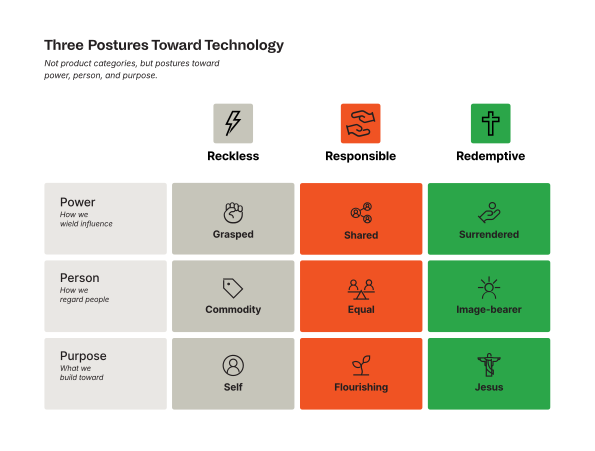
Reckless technology is a way of creating and using tools that place self above all else. It prioritizes speed, efficiency, control, and rapid growth over people. It carries a rebellious and anti-institutional posture, treating accountability, resistance, and human limits as obstacles to overcome.
In this posture, creators place their desires above the good of others, at the cost of others and even their own well- being.
“Move Fast, Break Things” is a mantra that ushered in a movement of tech start-ups beating down the door of institutional resistance to innovation. We celebrate how this movement pushed against the slow and counter-productive systems of old. Yet the mantra represents how speed can be chosen over thoughtful caution for repercussions. It chooses disruption over collaboration. It takes no care to avoid long-term human isolation and addiction.
Reckless technology moves rapidly without remaining accountable for what—or whom—it breaks.

1. Power Grasped
Reckless technology treats power as something to acquire, consolidate, and deploy to win. Its logic is frequently zero-sum: I win, you lose. Those creating technology extract value from those using it. We see this pattern repeatedly. Exploitative practices disguised as innovation move faster than law and faster than society can properly create the scaffolding to distribute safely.
What sits underneath this extraction is a fundamental thirst for god-like powers, reminding us of the serpent’s deception in our creation Gospel-lens. Technological power becomes a way to gain greater control, authority, and independence from others.
Dopamine loops, infinite scrolling, doomscrolling, echo-chamber, and engineered dependencies all drive exploitation over personhood. Attention, attachment, platform growth, and profit become the goal. Recklesstechnology uses power to take.
The same danger appears when we surrender morally significant human judgement to autonomous systems. To abdicate moral agency and human judgement is reckless because it surrenders humanity’s cultural mandate to take responsibility over created things on the earth.

2. Person As Commodity
The reckless posture views people as commodity. We use others for the value they can create for us. You’ve heard it said, “Users are data.” This is innovation that is set up to create wealth on one side, then continues mining value, information, and data that increases the ability to generate more wealth. It invades personal space to seize opportunity. It ignores privacy for the sake of an algorithm. This posture dehumanizes by disconnecting the “user” from the human. It cares only for the user on their platform, and not the human beyond the screen.
A person is reduced to a data point, a user, or a market to be exploited.
But human beings are not commodity. We are embodied image-bearer made to be seen, loved, known, addressed, and bound to others in relationships of mutual obligation. When a person is treated or used as a commodity or means to an end, they are no longer regarded as someone of equal or irreducible worth. They become objects to be manipulated and optimized.
Reckless technology uses people rather than loving them.

3. Purpose Toward Self
The reckless posture ultimately directs its purpose toward the self. Here we encounter both the Limitless Self and the Killer App Trap. Technological culture promises that we can transcend time, solve the world’s deepest problems, satisfy our desires, and become savior-like ourselves. Our desires are not questioned or reordered; they are amplified.
It reminds us of Babel, again, when humanity declares:
The aim was not simply to build a great city but to make a name for themselves. To secure their own glory, fame, and power.
Reckless technology design is driven by a builder’s self-glory, self-justification, and self-exaltation.
Put simply, reckless technology uses power to take, treats people as commodity, and builds to make the self great.
Responsible technology is a way of creating that intentionally considers the ethics, values, consequences, and negative impacts of our technological work. It seeks to create products, tools, and systems that promote harmony rather than division. It pursues unity, peace, and fairness.
In this posture, creators place their interests on equal footing with the interests of others.
“Slow Down, Fix Things” counters the reckless posture by slowing down to take stock of what kind of product or tool is being built, and how. It seeks to fix rather than break and aims for an ethics-based approach to solving problems rather than recklessly creating new ones. Responsible technology at its best does not react to the broken past but also proactively seeks to solve problems of the future.
Responsible builders move at a healthy pace, reflecting on whom they are accountable to and the consequences of theirs choices.

1. Power Shared
Responsible technology uses power carefully and shares it collaboratively, but it does not necessarily place that power fully under the lordship of Jesus or willingly surrender it at personal cost. It is an equal-sum game. I win; we win. Nobody loses. This equitable outcome is the primary goal of responsible technology. It is a great expression of common grace, where organizations, innovators, and developers look to create an environment where nobody is harmed.
What sits underneath this shared power are dignity and rights, common grace, safety, fairness, and accountability.
Responsible builders seek the common good of humanity and are therefore willing to sacrifice being first to ensure safety more broadly.
A responsible posture related to AI autonomy, for example, would be to ensure humans are not only in a position of oversight but guided fundamentally by human-designed guidelines and charter. It refuses to abdicate moral agency or treat AI as a person. A downfall of a responsible technological posture would be to accept something that is highly personalized while being profoundly impersonal.
Responsible technology uses power carefully and offers it collaboratively yet ultimately still prioritizes a way that leads to self-gain.

2. Person As Equals
Responsible technology views people as equal. It is based on a commitment to treating all people with equal respect and consideration, and it seeks to ensure that technology is developed and used in ways that promote social justice and equality.
Responsible technology seeks equal justice for all. “Learn to do right; seek justice. Defend the oppressed. Take up the cause of the fatherless; plead the case of the widow.” (Isaiah 1:17)
Caring for the weakest and most vulnerable is a great concern to God and His word. And to treat all as equal is a deeply biblical truth. Every person possesses equal dignity and worth before God.
For builders, this conviction should shape the products we design and the decisions we make. We consider who has access, whose voice is included, who bears the risk, and whether the technology distributes its benefits fairly.
Yet again the responsible posture can still fall short when people are only viewed as equal. We end up making decisions that seek a utilitarian outcome, hoping the most people can benefit. Yet God’s view of people is radically different, as we will see.

3. Purpose Toward Human Flourishing
Responsible technology is ultimately directed toward human flourishing. It seeks to create products and systems that are safe, fair, trustworthy, and genuinely beneficial. It reduces harm, protects the vulnerable, and asks whether innovation contributes to the common good.
Yet human flourishing is not self-defining. A product can be safe and useful while still encouraging isolation, dependency, disembodiment, or lives organized around consumption and efficiency.
The Christian story defines flourishing in relationship to God and neighbor. People flourish as embodied image-bearer who love God, love others, receive their limits, and live in authentic communities.
Responsible technology asks whether people are protected and benefited. Redemptive Technology goes further by asking what kind of people and world our product, systems, and machines are forming.
Remember, technology is not only an object we possess but the skilled and purposeful practice of creating—using knowledge, tools, and materials to shape the way of the world around us. Redemptive Technology, then, is the distinctly Jesus way of using knowledge, tools, and materials to make something of the world.
Redemptive Technology categorically rejects reckless technology and refuses to stop at responsible technology. Responsible technology asks how we can reduce harm, share power, and promote human flourishing. But the way of Jesus calls us further: to surrender power, sacrificially love people, and direct our work toward God’s glory and His mission.
“Sacrifice, Create Things” radically flips the narrative of reckless technology and calls us to a life of surrender for the benefit of others above ourselves. Rather than breaking things or fixing things as our mantra, we do God-centered design with creating as our vision for change.

1. Power Surrendered
The rightful way of power is that it is received from God, placed under his authority, and willingly risked or relinquished for the good of others.
Therefore, to build redemptively is to surrender our claim to ultimate power and control, placing both under God’s authority and allowing ourselves to be led by the Spirit.
The flesh bends our desires toward control, self-interest, and the grasping of power. The Spirit reshapes what we desire, forming us to use power for God’s glory and the good of others.
Jesus is the perfect example. He did not surrender power to become powerless. He placed his authority in service of others, and ultimately laid down his life. Creating in the way of Jesus therefore means using power not to secure ourselves or control others, but to serve, protect, and bear costs for their good.
Power is surrendered when builders willingly release control, invite accountability, and give people meaningful agency over the technologies shaping their lives. It means accepting less speed, profit, data, or influence when retaining those advantages would exploit others or place the product above their good.
Power is not inherently corrupting or something we should avoid. Power is part of bearing God’s image: the capacity to act meaningfully in the world, create possibilities, and enable life to flourish. The danger comes when power becomes idolatrous, coercive, or self-protective rather than generative.

2. Person As Image-bearer
The rightful way of regarding people is to recognize that every person belongs to God, bears his image, and is called to live in a loving relationship with God, neighbor, and creation.
Therefore, to build redemptively is not only to protect people from harm or treat them fairly. It is to sacrificially love them as neighbors whose worth does not depend on what they produce, purchase, contribute, or make possible for us.
People are loved as image-bearer when builders refuse to reduce them to users, data, or means to an end. We remember that every colleague, customer, and community affected by our work belongs to God before they belong to our team, platform, or organization.
This means asking more than whether a product, system, or practice is safe, fair, or useful. We ask whether it helps people live more truthfully as embodied creatures, responsible agents, loving neighbors, and worshippers of God.
This posture also changes the process of creating. The product development cycle becomes a disciple-forming journey toward Jesus. We place a high value on the human interactions involved in creating a product and on the relationships formed along the way. We believe some of the greatest potential for long-term redemptive impact exists in the people developed, loved, and formed as we build together.

3. Purpose Toward the Mission of Jesus
Colossians 1:15–20 tells us that all things were created through Jesus and for Jesus. He stands above every power and authority, holds all things together, and reconciles all things through the blood of his cross. The materials we shape, the minds with which we imagine, the people affected by our work, and everything we make ultimately belong to him.
The rightful purpose of technology is therefore to serve the mission of Jesus: loving God, loving our neighbor, making disciples, and bearing faithful witness to the kingdom he will fully establish when he returns. To build redemptively is to place our everything under the lordship of Jesus and direct everything towards his mission.
The Great Commandment and Great Commission belong together: we serve the real needs of our neighbors while bearing witness to the One apart from whom they cannot fully flourish.
Technology cannot save a human soul. Jesus alone redeems. Yet our making can serve his mission by strengthening faithful communities, removing barriers to the Gospel, and creating opportunities for truth, reconciliation, and faithful presence.
This does not mean every redemptive product must explicitly communicate the Gospel or function as a discipleship tool. A payroll system, accessibility tool, or piece of infrastructure can serve the mission of Jesus through truthful design, excellent work, sacrificial love, and genuine service to neighbors. Redemptive Technology asks that all our making be placed under the lordship of Jesus, not that every product perform the same role within his mission.
Revelation gives this mission its final horizon: Jesus returns, evil is judged, God dwells with his people, and all things are made new. Technology cannot usher in that kingdom, but it can become a sign of it. We therefore build with hope and urgency, seeking not only better products and systems, but people reconciled to God and formed for life in his coming kingdom.
All things were created through Jesus and for Jesus—including what we make.
Conclusion
In conclusion, creating in the way of Jesus means surrendering power, loving people as image-bearer, and directing our work toward his mission. A redemptive posture must become a redemptive practice—shaping how we identify problems, make decisions, develop solutions, and measure their fruit. What we believe about technology must now shape how we create.
Reflect and Discuss
Bring one current product, feature, team practice, or strategic decision into the framework of power, person, and purpose:
- Power: Who holds influence, and how it is being exercised?
- Person: How are people being understood and treated?
- Purpose: What ultimate purpose directs this work, and whose purposes does it serve?
- What might creating in the way of Jesus require you to surrender, change, or pursue differently?

.svg)
FaithTech Team
First published as The FaithTech Playbook: Building Technology Redemptively in 2023.
Revised and expanded edition published in 2026.
Copyright © 2023, 2026 FaithTech Inc.
FaithTech is a global community for Christ. We meet in cities all over the world.
We gather as technologists, entrepreneurs, designers, ministry leaders, pastors, students, and builders who want to resist the dominant patterns of the technology industry and practice a different way—a Jesus way.
Join the movement at faithtech.com