A Different Way
There is a uniquely Jesus way of building technology. A redemptive way.
A way that brings faith into the entire product design and development cycle, embedding biblical beliefs and values into the methods of creation so that our products more fully align with God’s vision for the world.
A transformative process that leads to transformational products. Shaping what we make and who we become as we make it.
Beautifully, it is the very individuals creating who can be transformed in that process. A team formed around biblical values and beliefs can, in turn, be formed in Christlikeness through the work of creating. A transformative process that leads to transformed people.
Redemptive Technology, as we say, is the distinctly Jesus way of using knowledge, tools, and materials to make something of the world. The way of Jesus is radical, uncompromising, and countercultural. Jesus did not offer a better version of the world’s way. He revealed a different way—one marked by humility, sacrifice, truth, love, and surrender. He calls us not only to think differently, but to live differently, and to create differently.
To create redemptively.
In other words, we believe there is a way of building products that redemptively changes the world while transforming those who build it.
This belief has led our community to develop a redemptive way of building products. A different way that examines and questions the modern practices of technology companies while adopting its most useful methodologies where they align with the way of Jesus.
We believe that we—as designers and builders—are created by God in a particular way. We have a way of seeing a problem that God has uniquely instilled in us to advance his kingdom here on earth.
Therefore, our community has developed a way of being a builder that is rooted in the core teachings of the Word of God. It is a way that roots our identity as creators in the way of Jesus, his word, and his practices.
We made this playbook because technology is forming the world and forming us.
We need more than useful tools, better ethics, or faster innovation; we need a way of creating that is rooted in Jesus. This playbook draws on years of iterating—thinking, testing, dialogue, dismantling, testing again, and re-engineering. We collected ideas and methods from hundreds of volunteers around the world who are part of our practicing community. To ensure this playbook is theologically rigorous and practically useful we gathered focused input from world-class practitioners and thought leaders.
This updated 2.0 version considers hundreds of people using these frameworks all over the world, whether it be teams creating tools, professors teaching our frameworks, or companies formed based on the ways described in this playbook. Each story has helped us improve this edition and makes up this unique and growing global tech community for Christ.
Therefore, we write as a community, for a community.
We write as a community desiring a different way of practicing technology. A way that aligns with our faith. A way that unifies our faith with our work of creating.
We write for those in our community confused, concerned, or contemplating the future of software development and the wider technology industry as artificial intelligence not only shapes the future of work but seemingly our future identity as humanity.
We write for those in our community longing to see their one o’clock design thinking meeting or their four o’clock strategy session impacted not only existentially by who they are as followers of Jesus, but also practically by bringing in new language and methods of creating.
We write for those in our community feeling a disconnect between their personal beliefs and the implicit beliefs of the technology industry.
And we write for those in our community longing to create in ways that help humanity become people who love God and love others more deeply.
As you venture forward in reading and applying this playbook, we venture with you, beside you.
This playbook unfolds in four parts.
Part 1
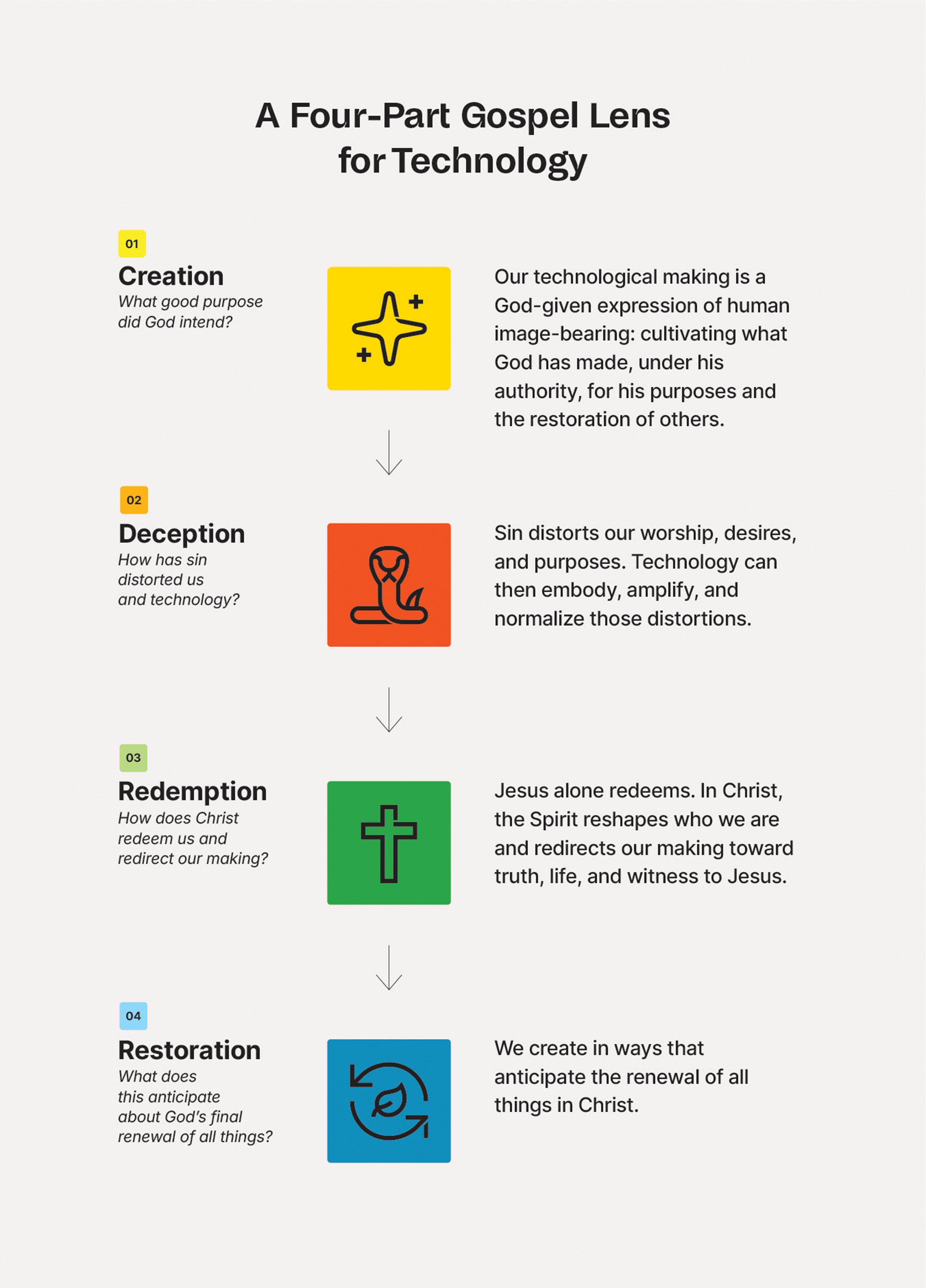
A Different Way introduces the theological vision behind Redemptive Technology and offers four Gospel lenses—creation, deception, redemption, and restoration—for understanding the human practice of technology within the biblical story.
Part 2
The Way of Technology examines the disproportionate formative power of technology and names three ancient enemies beneath our technological age: the Magic Machine Myth, the Limitless Self, and the Killer App Trap.
Part 3
A Way of Being Redemptive explores three postures toward technology—reckless, responsible, and redemptive—through the categories of power, person, and purpose.
Part 4
A Way of Building Redemptively translates this redemptive posture into a practical, repeatable process: Lament, Discern, Build, and Steward.
Together, these four parts move from theology to spiritual discernment, from posture to practice—shaping what we believe about technology, how we recognize the forces forming us, who we become as builders, and how we create in the way of Jesus.
See It In Action
After each major section, you will find a See It in Action box. Each box will have a QR code that will direct you to real stories and case studies, further reading, and practical resources related to that part of the playbook. Additionally, we have included a few reflection questions for you or a group to dive deeper into the major ideas.
The See It In Action sections are designed to help answer two questions:
- What will I do because of what I have read?
- How will this change the way I live and build?
While this Playbook is written from within the Christian story and for followers of Jesus, we believe its questions matter for anyone creating products: What kind of power are we using? What kind of people are we becoming? What kind of world are our tools helping create?
This playbook is intended for practice, not contemplation alone. Read it with others. Question it. Test the language. Apply the practices. Bring it into a real problem, a real team, and a real product.
Build something together.
FaithTech is a global tech community for Christ. We gather people who work in and around technology that want to follow Jesus faithfully.
We gather technologists, entrepreneurs, designers, ministry leaders, pastors, students, and builders in cities around the world. Some are creating products, some are leading teams, some are serving churches and ministries, and others are simply trying to understand what faithfulness looks like in a rapidly changing technological age.
What unites us is not a particular occupation, product, or platform. It is a shared conviction that our technology is forming the world and forming us, and that followers of Jesus need more than good intentions or better ethics. We need a distinctly Jesus way of thinking, living, and building.
FaithTech exists to help cultivate that way. Through local communities, practical projects, theological reflection, and shared practices, we seek to resist the dominant patterns of the technology industry and learn to create in the way of Jesus.
This playbook has grown out of that community. It carries the questions, experiments, failures, insights, and practices of builders around the world who are trying to unite their faith with the work of technology.
We invite you to join us—not simply to read these ideas, but to test them in community, apply them to real problems, and help us continue to learn what it means to build redemptively.
Join the movement at faithtech.com.
First, what do we mean by technology?
Our friend Dr. John Dyer defines it this way: “Technology is the human activity of using tools to transform God’s creation for practical purposes.”
The critical element is that technology is more than just the tools we use but rather it is an activity that we do. The word technology comes from the Greek technē, meaning craft, skill, or art, and logos, meaning reasoned account or study. At its root, then, technology is not simply an object we possess but the skilled and purposeful practice of creating—using knowledge, tools, and materials to shape the way of the world around us.
A helpful way to understand human activity within the biblical story is through the four-part Gospel lens of creation, deception, redemption, and restoration. Scripture has much to say about our calling to create, the ways that calling is distorted, our responsibility as builders, and how our work fits within God’s purposes for humanity.
The way we see it is that technology is a God-given expression of human image-bearing, distorted by sin and deception, redirected through builders redeemed and formed by Jesus Christ, and practiced now as a witness to God’s promised restoration. Let’s explain this in greater detail.
Creation
The origin story of technology does not begin with a garage in Silicon Valley. It begins in Genesis 1.
“In the beginning God created the heavens and the earth” (Gen 1:1, emphasis added). The first action Scripture reveals God taking is creating. The Hebrew word used here for “created” is bara. It is a very specific word reserved for God’s work of creation as the sole inventor. God created out of nothing. Humanity requires something to make anything. God required nothing to make everything.
It is vital we sit with this for a moment. The Creator of the heavens and the earth, in all his magnificence, magnitude, and beauty, decided to create. His creativity and power have no limits. He is all-powerful. All-knowing. All-present. Eternal. He chose to make us and the world and universe around us for his glory and our communion with him. “For in him [Jesus] all things were created: things in heaven and on earth, visible and invisible, whether thrones or powers or rulers or authorities; all things have been created through him and for him” (Col 1:16). The Lord is the great Creator. The great Pioneer. The source and sustainer of all things.
In Genesis 1:26, God says, “Let us make mankind in our image.” In our human origin story, we see three important lessons that relate to how we are to create redemptively.
First, “let us make.” God is revealed throughout Scripture as Father, Son, and Holy Spirit. Creation is the work of the triune God, not an act of isolated self-expression. We are reminded that faithful creating is relational. We build in dependence on God and in committed community with others, receiving wisdom, insight, and gifts we do not possess alone. Creating is relational.
Second, “let us make mankind.” God is the Creator, and humanity is his creation. The making of humankind is itself a breathtaking act of divine creativity: From the dust of the earth, God formed living persons who could know him, reflect him, love, imagine, cultivate, and create. Remarkably, the Creator gave his image-bearer a capacity that reflects his own activity. We were created by the Creator to create; our making is derivative of his making. When we make, we live into our vocation as image-bearer—working with materials God has already made, under his authority and for his purposes. Creating is vocational.
And third, “in our image.” Every human being bears the image of God. Throughout the creation account, God places his image in humanity alone. Human worth is therefore not earned through intelligence, productivity, usefulness, or technological ability; it is given by God. Redemptive builders, then, must never reduce people to users, data, markets, or means to an end. We create for people who belong to God and bear his image. Creating must honor the image of God in every person.
To bear God’s image is to reflect him in what we create, how we create, and how we treat the people affected by our work. As builders and designers, we represent him throughout the entire process.
Our responsibility as image-bearer includes the calling to cultivate, develop, and steward the world God has made. We create because God designed humanity to create. We build because God called us to build. We innovate because God set forth such a simple yet courageous responsibility on humanity—fill the earth and subdue it.
Humanity receives a world already filled with materials, energy, possibility, and order—and is called to cultivate what God has made into new forms that serve his purposes.
Jesus Christ fulfills the cultural mandate perfectly as the true image of God and the faithful human who uses power, creativity, and authority exactly as God intended. In Christ, humanity’s work of cultivating the world—including our technological work—is rescued from domination, exploitation, and self-glory and redirected toward surrender, responsibility, and love.
Through his death and resurrection, Jesus begins the renewal of all creation and, by his Spirit, restores us to our vocation as makers under his authority. We therefore create and build not to save the world or make a name for ourselves, but to participate faithfully in Christ’s kingdom and bear witness to the restoration he alone will complete.
Deception
After God called Adam and Eve to steward the earth, sin entered the world through deception and lies. It does not destroy our image-bearing capacity to create; it distorts the worship, desires, and purposes directing it. Technology therefore cannot be understood as neutral tools in fallen hands: the tools, systems, and methods we create can embody our lies, amplify our disordered desires, and normalize them across societies.
The deception deployed by the serpent (the devil) is rooted in causing humans to question God’s truth (“Did God really say, ‘You must not eat from any tree in the garden’?”), contradict God’s truth (“you will not certainly die”), and offer God-like powers (“you will be like God, knowing good and evil”). The central deception, then, is an invitation to pursue God-like status independently of God.
It is the same temptation repeatedly presented to humanity through technological power: that with enough knowledge, innovation, or control, we can overcome dependency and become masters of our own existence. The flesh—our sinful nature and its disordered desires—takes the serpent’s lie inward, bending our hearts toward autonomy, control, and God-like power apart from God.
Fallen humanity often uses tools and technological systems as a covering—something we use to manage symptoms, conceal vulnerability, or avoid the deeper truth about ourselves. In our story, Adam and Eve respond by covering up their guilt and shame with prototype clothing, hiding out of fear, and blaming others.
We see deception take form within humanity again when a new technological development—brickmaking—gives way to a new opportunity to be like God. Civilization decided to build a tower to reach the heavens. If they could reach up to God, they would become famous and powerful. When God saw it, he said that “nothing they plan to do will be impossible for them” (Gen 11:6).
The world believed they could leverage technology to use God for their own benefit. Though technology itself does not create the deepest disorder of the human heart, it can embody, amplify, and normalize it. It can easily magnify the deception, sin, and idolatry of the human heart. What begins as deception in the heart can become architecture, infrastructure, culture, and empire.
Technology does not create the fallen heart, but fallen hearts create tools that can then form other hearts. We were made to cultivate creation. After the fall, the same capacities for imagination, skill, power, and organization can be directed toward false worship and self-rule. Our technological ability remains; its direction is distorted.
If the deepest distortion beneath technology lies not only in the tool but in the worship, desires, and purposes of the people who create it, then better tools alone cannot save us. The builder must be redeemed and formed anew.
Redemption
The deepest problem beneath technology is not a lack of human ingenuity, but the alienation, idolatry, and disordered desire of the human heart. We therefore need more than improved tools or better ethics. We need redemption.
Then we get the greatest news of all. The Lord redeems. His redemptive plan happened through the life, death, and resurrection of Jesus Christ.
Jesus came to earth not to optimize the world, but to save it. Not to make us more efficient but to deal with the thing we can’t fix ourselves. Our sin. Our guilt. Our brokenness.
As Dyer explains, “The cross…is a symbol of the distorted creation turning on its Creator. That twisted tree represents the twisted us, a humanity transformed by sin and bent toward death…the Creator was rejected by his own creation.”1 Jesus takes the technological symbol of pain, intimidation, and rejection and redeems it to become a symbol of hope, joy, and salvation. He takes our sin and redeems us back to God.
We are given a new identity. A new heart. A new allegiance. A new freedom from our work justifying our worth or a success defining our purpose. Jesus makes all things new.
Then, after His crucifixion on the cross, after three days, Jesus is raised from the dead. The resurrection of Jesus Christ points to His renewal of creation, his rejection of technological immortality as salvation, his commitment to embodiment, his promises fulfilled, and his hope beyond death.
Through technology, people can do a lot of incredible things: protect life, serve justice, resist exploitation, or be an instrument of loving our neighbour. Technology is not, in and of itself, redemptive. Jesus redeems. Therefore, when we use the words redemptive technology, we mean the distinctly Jesus way of using knowledge, tools, and materials to make something of the world. It is a Spirit-led way of creating, that at its core, points everyone and everything toward Jesus.
This Spirit-led way of making is illustrated well in Exodus 31. To build his dwelling place, the tabernacle, the Lord had “chosen Bezalel...and...filled him with the Spirit of God, with wisdom, with understanding, with knowledge and with all kinds of skills...to make...artistic designs” (Exod. 31:2–5). God chose skilled workers and gifted them with the abilities needed to create a place where people could worship him. Their work was not just productive; it was faithful service and worship before God.
Like Bezalel being filled with the Holy Spirit, the Lord pours out his Spirit on his people. The Holy Spirit can move through technological making, but no machine can contain him and no system can manufacture spiritual life. He works in and through people—calling, guiding, convicting, renewing, and empowering them to turn the tools of their age toward truth, love, and a living witness to Jesus.
Redemptive Technology begins with builders who are themselves being redeemed, because the Gospel reshapes not only what we build, but why and how we build—and who we become in the process. It reminds us that our hope was never meant to rest on what we build but who we belong to. We do not build to become worthy, powerful, or saved. We build because in Christ we already belong to God.
Then, we are sent forth to go into all the world to make disciples of Jesus Christ, in all domains, in all places, to all people, for all to know One person. That Spirit-empowered mandate offers a redemptive vision as builders to go live and build in such a way the world sees Jesus in us and through us, not for us, but for Him.
Restoration
The Gospel does not end with humanity escaping creation, but with God restoring it.
The apostle John writes:
The biblical story begins with God creating the heavens and the earth and ends with God renewing them. It begins in a garden and ends in a city. Creation is not discarded. It is made new.
The New Jerusalem also stands in contrast to Babel. At Babel, humanity built upward to make a name for itself and secure its own future. In Revelation, the Holy City comes down from God as a gift. Humanity does not engineer its way to heaven; God brings heaven and earth together through his presence.
This promised future gives builders both hope and limits. We work with hope because creation matters to God. But we work with humility because no product, platform, or breakthrough can bring about the new creation. We cannot eliminate sin, conquer death, or manufacture the kingdom of God. Jesus alone will complete that work.
This frees builders from the burden of saving the world. We can create with courage without believing everything depends on us. We can build with urgency, but not desperation; with ambition, but not self-glory; with hope, but not faith in technological progress.
God’s promised restoration also directs our making. We do not create the future God has promised, but we can create in ways that agree with it: toward truth rather than deception, reconciliation rather than division, communion rather than isolation, and life rather than death.
The Lord offers a radical vision for how we make technology. What we build matters—not because our inventions will last forever, but because faithful making can carry eternal significance, bearing witness in the present to the world God has promised to restore. Put simply, we cannot create the kingdom, but our creation can sow seeds that witness to the world God will restore.
Conclusion
Technology is a God-given expression of human image-bearing, distorted by sin, redirected through builders being redeemed and formed by Jesus, and practiced now as a witness to God’s promised restoration. It is never merely the use of neutral tools; it is a human activity shaped by what we worship, what we desire, and what kind of world we are trying to create.
Since technology shapes the world, it also shapes us. To build redemptively, we must first understand the spiritual forces forming both what we create and who we become.
1 John Dyer, From the Garden to the City, 2011 edition: p 137
Reflect and Discuss
Choose one product, system, or technological practice and examine it through the four Gospel lenses of creation, deception, redemption, and restoration.
- Where do you see humanity’s God-given capacity to create?
- Where do you see sin, deception, or disordered desire shaping it?
- Where might Jesus redirect the builders and their product or practice toward truth, love, and life?
- How does God’s promised restoration give you both courage and humility?

.svg)
FaithTech Team
First published as The FaithTech Playbook: Building Technology Redemptively in 2023.
Revised and expanded edition published in 2026.
Copyright © 2023, 2026 FaithTech Inc.
FaithTech is a global community for Christ. We meet in cities all over the world.
We gather as technologists, entrepreneurs, designers, ministry leaders, pastors, students, and builders who want to resist the dominant patterns of the technology industry and practice a different way—a Jesus way.
Join the movement at faithtech.com